 English
  German
  Spanish
  Italian
  Russian
  Arabic
  Korean
  Japanese
  French
  Dutch
Dutch  Danish
  Norwegian
  Portuguese
  Turkish
  Czech
Czech  Lithuanian
  Polish
  Slovenian
 Why Small Silicone Parts Need More Than Simple Molding
A small silicone valve may look simple, but stable production depends on mold design, flow control, venting, shrinkage compensation, and curing stability.
The Real Problem Was Consistency, Not Price
Silicone parts often look simple. But when you start sourcing them, the problems show up fast.
A buyer once came to us with a small silicone valve used in a food pouch. The part was light, under one gram. The design looked clean. But production kept failing.
The issue was not price. It was consistency.
At that point, the sourcing question changed from "Who is cheaper?" to "Who can make it stable?"
Customer Need: A Valve That Opens at the Right Pressure
For this application, the valve had to open at a specific pressure. If the silicone was too soft, the valve leaked. If it was too stiff, it blocked flow. The tolerance window was tight.
The customer had already tried two suppliers. Both delivered samples that passed initial testing. But after scaling up, defects appeared. Flash, size variation, and unstable opening pressure made the parts unsuitable for mass production.
The goal was not just to make approved samples. The goal was to make a valve that worked the same way across production batches.
Manufacturing Challenge: The Risk Was Built Into the Mold
When we reviewed the part, the production risks were clear.
- The wall thickness was uneven
- The flow path was long and narrow
- The sealing edge sat on the parting line
- The venting area was limited
Each of these problems can be managed on its own. Together, they create a much higher risk of unstable production.
Flash formed along the sealing edge. Shrinkage changed the opening pressure. Air traps caused small burn marks. These were not random defects. They were signs that the mold design did not match the behavior of liquid silicone rubber.
The previous suppliers tried to solve the problem with pressure and temperature adjustments. It helped for a few cycles, but it did not create a stable mass production process because the root cause was in the mold.
Technical Approach: Start With Mold Design
We started with the mold, not the machine.
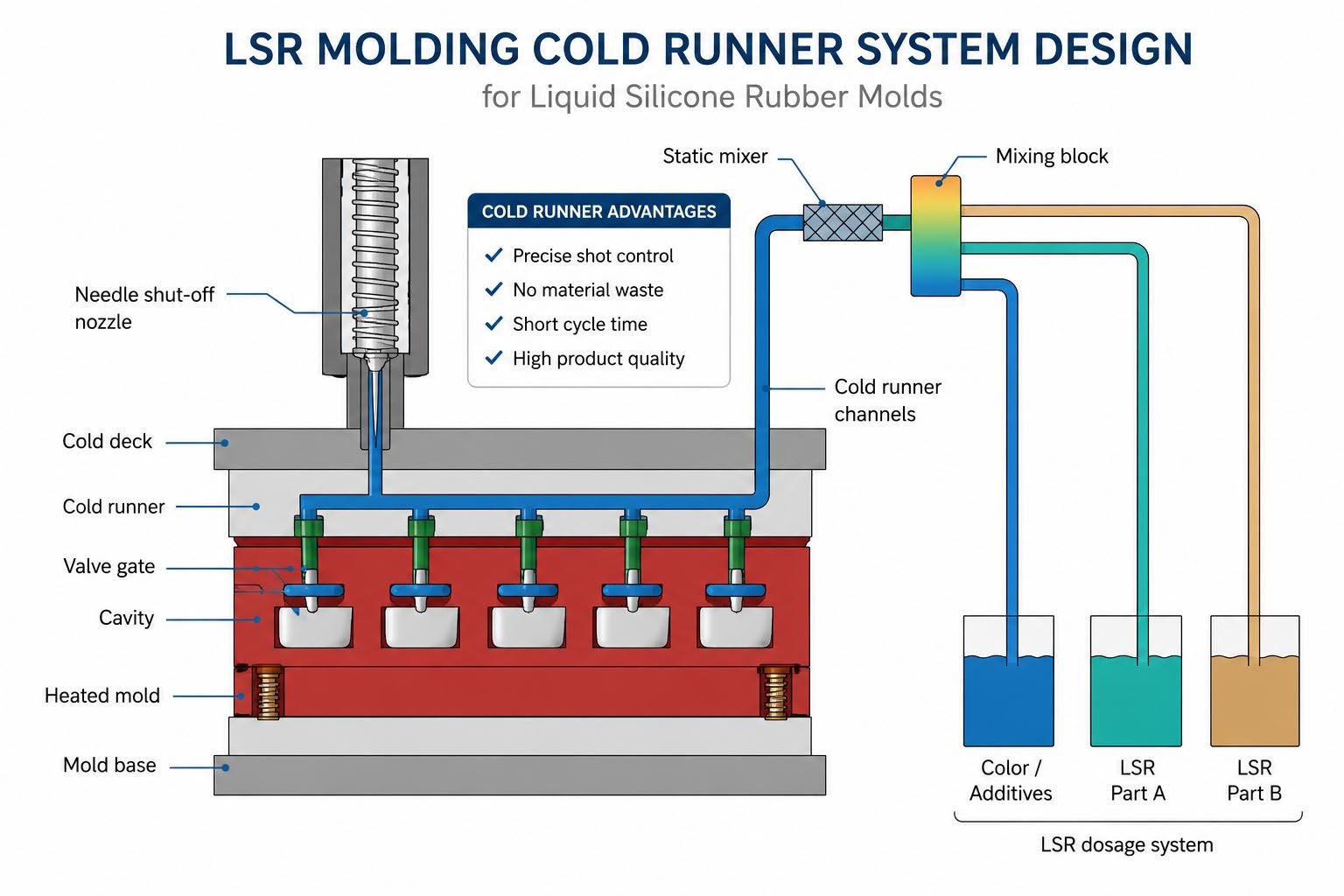
- Gate location was adjusted. This shortened the flow path and made cavity filling more balanced, reducing the risk of incomplete filling and uneven curing.
- The parting line was redesigned. We moved it away from the sealing area and improved surface matching to reduce flash risk.
- Micro vents were added at the last fill area. The vent depth stayed within a tight range, around 0.004 mm.
- Vacuum was added during injection. This helped remove trapped air before it could cause burn marks or incomplete filling.
- Shrinkage compensation was applied by direction and wall thickness. This kept final valve geometry closer to the required performance window.
Before cutting steel, we verified the filling behavior with moldflow analysis. During trial runs, we focused on temperature stability and kept variation within a narrow range to support even curing.
These steps did not make the mold more complex. They made it more predictable.
Application in Real Use: Stable Performance Across Batches
After these mold and process changes, the valve performance stabilized.
- Opening pressure stayed within the required range
- Flash was no longer visible on the sealing edge
- Burn marks disappeared
- Batch-to-batch consistency improved
The customer tested the parts in real filling lines. The valves performed consistently across batches, which allowed the project to move forward into production.
What This Shows About Silicone Part Manufacturing
From the outside, this looked like a small part. But stable production depended on how early the manufacturing risks were identified.
If a supplier focuses only on molding, they react to defects after they appear. If they understand mold design, they prevent many of those defects before production starts.
You can often see the difference during the early project stage. A capable silicone molding supplier will not only quote the part. They will review the design and explain the production risks.
In LSR molding, the mold is not just a tool. It is where quality begins.
Signs of a Reliable Silicone Molding Supplier
Before starting tooling, it is worth asking a few practical questions:
- Do they review your part design before mold making?
- Do they discuss flow path, venting, and shrinkage?
- Do they explain where flash may appear?
- Do they understand how parting line position affects function?
- Do they validate the process for repeatable production, not just sample approval?
These are signs of real manufacturing experience.
Need Help With Silicone Valve Manufacturing?
xflsrmolding supports custom silicone valve manufacturing, LSR mold design, flash control, vacuum-assisted molding, and stable mass production for food-grade, medical, and industrial silicone components.
Contact our engineering team to review your silicone part design and discuss the best molding strategy for stable production.